
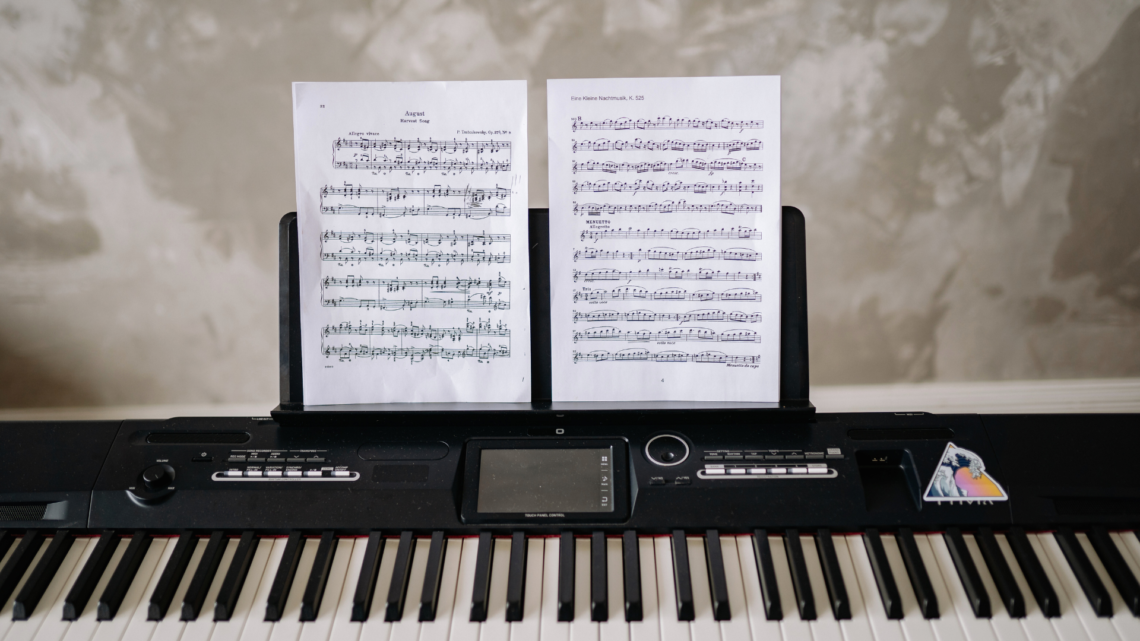
You’ll start making sense of melody, harmony, and improvisation by learning a few practical scale shapes and how they map to chords. Practice a simple major and minor scale pattern, then apply those notes over matching chords to hear how scales create musical direction.
They can use scales to build solos, write hooks, and choose chord tones that fit a mood. The article shows step-by-step ways to practice patterns, connect scales to common chord progressions, and turn theory into playable ideas.
How to Use Music Scales
Scales define pitch order, interval relationships, and the tonal center musicians rely on. Practicing and applying specific scale types builds technique, guides harmony choices, and shapes melodic sentences.
Understanding the Structure of Scales
A scale is an ordered set of pitches arranged by ascending or descending intervals between the tonic and its octave. The most common diatonic pattern in Western music is the major scale: whole–whole–half–whole–whole–whole–half (W W H W W W H).
Minor scales exist in three common forms: natural (Aeolian), harmonic (raised seventh, producing an augmented second between the sixth and raised seventh), and melodic (raised sixth and seventh ascending, natural minor descending). These changes affect leading tone behavior and dominant function.
Intervals (whole steps = two semitones, half steps = one semitone) determine scale degree quality: tonic (1), supertonic (2), mediant (3), subdominant (4), dominant (5), submediant (6), and leading tone or subtonic (7).
Understanding interval patterns allows quick transposition: apply the pattern of whole and half steps to the tonic to build any major or minor scale (C major = C D E F G A B C; A minor = A B C D E F G A).
Major and Minor Scales in Practice
Musicians use the major scale for diatonic harmony and melodic construction; it defines key signatures and functional chord progressions. Practicing all 12 major scales across the piano keyboard or a fretboard develops finger patterns and ear recognition of scale degrees like the leading tone and dominant.
For minor keys, practice natural, harmonic, and melodic forms to understand the harmonic minor’s raised seventh (creates a strong dominant) and the melodic minor’s ascending alterations (smooth melodic motion).
Apply scales directly: improvise over a I–IV–V progression using chord tones emphasized on strong beats, then use passing tones from the scale on weak beats. Use scale-degree awareness to target chord tones (e.g., resolve a 7th to the tonic on dominant–tonic cadences). Practice with metronome, varied articulations, and sequences to build fluency in keys like G major, E minor, and F minor.
Applying Pentatonic and Blues Scales
Pentatonic scales (major pentatonic: 1–2–3–5–6; minor pentatonic: 1–b3–4–5–b7) remove semitone tensions and suit many genres. They work well with static harmony or quick changes because their limited notes reduce dissonance. Major pentatonic (C–D–E–G–A) fits major tonal centers; minor pentatonic (A–C–D–E–G) fits minor tonal centers and is common in rock and blues.
The blues scale adds a blue note (flat 5 or augmented 4): 1–b3–4–b5–5–b7. That flat-5 creates expressive tension and characteristic blues phrasing. Players use bends, slides, and call-and-response motifs to emphasize blue notes and microtonal inflections.
Practice pentatonic and blues scales across positions, then apply them to solos by targeting chord tones on strong beats and using scale fragments for motifs. Experiment with major pentatonic over dominant chords for a brighter color.
Exploring Chromatic, Whole Tone, and Modal Scales
Chromatic scale: all twelve semitones within an octave. Use it for chromatic passing tones, approach notes to chord tones, and voice-leading that links diatonic harmony. Practice chromatic lines to improve fingering and intonation; use them sparingly in melodies to avoid losing tonal center.
Whole tone scale: six equal whole steps (hexatonic). Because it lacks leading tones and tritones resolve ambiguously, it creates an ambiguous, floating sound useful for impressionistic harmony and altered dominant colors. Apply whole tone material over augmented or altered dominant chords for color without strong resolution.
Modes (Dorian, Phrygian, Lydian, Mixolydian, Aeolian, Ionian, Locrian) derive from major scales by rotating the interval pattern. Use modes to evoke different tonal centers and modal harmony: Dorian for minor with raised sixth, Mixolydian for dominant-flat-seven sound, Lydian for raised fourth brightness.
Other scales—diminished (octatonic), harmonic/melodic minor-based modes, Hungarian minor, maqam, and various world systems—provide exotic interval patterns like augmented seconds or microtones. Study their interval patterns, practice on the instrument, and apply selectively to match the harmonic context or cultural style.